
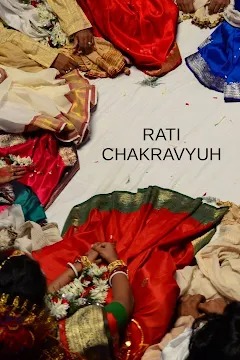
(Ashish Avikuntak talks about ‘Rati Chakravyuh’)
On a lunar clipse midnight, in a desolute temple, six young newlywed couples and a priestess meet after a mass wedding. They sit in a circle and talk. This is their last conversation – an exchange about life, death, beginning, end and everything in between. After a discussion that last more than an hour and a half, they commit mass suicide. ‘Rati Vhakravyuh’ (2013) is a “single shot feature film”, also called “continuous shot feature film”, a full-length movie filmed in one long take by a single camera.
- Let us talk about Rati Chakravyuh. It is very different from your earlier films. Tell me how it was shaped into a film
The idea of Rati Chakravyuh came soon after I finished my second film Katho Upanishad in 2010. This was a film that was based on the sixth century BCE Upanishad – one of the earliest Upanishads to be translated and made famous in the western world. It is conversation between the devotee Nachiketa and Yama – the God of Death. I wanted to continue my dialogue with death. I was thinking about Bible and the idea of the Last Supper dawned on me. Simultaneously, I was intrigued about the possibility of a conversation between people before they committed suicide – a mass communitarian suicide. It was with these ideas I started writing the dialogs. This film is a trifurcation of three ideas – the biblical Last Supper, the idea of cult communitarian suicide and the Bengali adda – but a specific form of adda – that of the “Bashor Ghar” – which is the first night spent by the bridegroom at the bridal residence. It is a form of gathering that happens on the wedding night, where social norms are loose and cultural transgression is permissible. With these as the key ideas I began writing the dialogs.
- Movement is the basic / existence of universe. Your film deals with two kinds of movements — continuous movement of camera and continuous flow of dialogues.
The phenomenological of the cinematic image in Rati Chakravyuh is based on a structural trifurcation. The cinema of the film is located on three axes – the circular movement of the camera, the spiral movement of the dialogue and the temporaility of the single shot. It is through the circular motion of the camera within the singularity of temporaility and the dialogical universe that the spiral is created. This creates the Chakravyuh. It is movement in one direction – a direction that leads to death – an end that is not the end, but an end nevertheless.
- The entire film (102 mins.) is taking place inside a temple. It is a continuous circular dolly shot. It is like we trapped in a whirlpool in the world of continuous dialogues and continuous camera movements as if we have entered into a chakravyuh like Abhimanyu.
The cinematic experience of Rati Chakravyuh is produced within a circle that produces spirals. The actual production of the film is made possible with a circular track dolly over which the camera goes around 56 times in 102 minutes. It is a dolly of 16 feet diameter within which the actors sit. In Hinduism and Buddhism the practice of circumambulation is an important part of ritual involved in a temple visit. Here the devotee circumambulates around the deity, or sacred spatiality (temple or even a sacred city). In Rati Chakravyuh this circumambulatory structure becomes the core of the cinematic experience. The ontology of the filmic experience is its circumambulatory motion and the epistemology of the film is its dialogical narrative. It is the combination of the two that produces the metaphysical spiral mentioned in the title. To put in another way, the temporality of the film (single shot, 102 minutes) is affected by the epistemology of the dialogs (multi-narrative aurality) and the ontology of the camera movement (circular dolly shot which makes 52 circumambulation) to create a metaphysical resonance.
- The film is filled with endless dialogues. Was this entirely written in advance or was there any improvisation? Was there any editing on the dialogues? How this was conceived?
It is virtually a scriptless film, there was no script in the traditional sense. The dialogues were written in a couple of weeks, in February 2011, in almost a deluge of words that poured out in the middle of nights. It was a stream-of-consciousness outburst. The question was: “What would be the nature of the last conversation between a bunch of people who know that they will kill themselves?” This is the ultimate existential scenario for me. Here death is voluntary and fearless. With this basic idea, I started to write: I let my mind meander in any direction it liked and, by the end of this process, I had nearly 200 pages of dialogues. Then, I did some editing and sent the dialogues to my collaborator Sougata Mukherjee in Calcutta. We did some more editing and, finally, the dialogues were given to the actors. We gave the actors a month to memorize their lines and then we rehearsed for six weeks. We shot the film in two days. In Rati Chakravyuh, the moment of spontaneity and unplanned-ness was the moment when I was writing the dialogues and the moment when we were shooting the film. The dialogs in this film were set in stone and no-deviation was allowed, however there was space for improvisation in the form of acting and gestures. During the six weeks rehearsals I spent time working with each actor and configuring the larger performative structure of the film. Intonation of the dialogs, the stoic nature of the acting, the controlled nature of gestural interplay was worked out during the rehearsals.
- The entire film is shot inside a temple. Why the temple? Is it that the location inspired you to write the film?
As Rati Chakravyuh is based on my conscious and subconscious memory, I wanted to shoot the film in my city, Calcutta, and that was sacred to me. I was very keen to shoot the film in what in Bengal is called a “Durga Dallan”. It is a large temple-courtyard situated inside a domestic house, mostly in palatial palaces that emerged in Bengal during the 18th century. Newly minted Zamindars (landlords) under the British East India Company made these larger houses and housed within it were this scared domestic spatiality. The sacred temple space inside a domestic habitation is peculiar architectural formation that emerged in north India during the end of the Mughal rule. Some of the earliest of such temple-domestic space is seen in North Indian temple towns of Mathura and Vrindavan. Although there is a history of sacred space existing in a domestic architectural formation in the Indian archaeological record, but it sees a proliferation in north India around the end of the regime of the Mughal emperor Aurangzeb in the late 17th century. Calcutta has vestiges of innumerable such “Durga Dallan”, especially in the older parts of north Calcutta build mostly in the 18th and 19th century. The major usage of these “Durga Dallan” was to host seasonal worship of mother goddess in its varying forms – the most popular being the Goddess Durga and Kali. During the reconnaissance for locations, I saw a number of these sites. I chose Latu Babu Chatu-Babu’s house especially because the energy at that location intuitively resonated with me. It was a “Durga Dallan” located in the palatial house of the Ishwar Ram Dulal Deb, where the worship of the Durga was been done continues for more than two centuries starting in 1770. It is difficult to articulate what was the nature of that resonance, but it seemed to be exactly the location I wanted. I was looking for energy and this space reverberated with the energy I was seeking. During the shoot, the effect of this energy resonated with everyone working with the film.
- Dialogues are open ended. No conclusion is drawn. There is as if no beginning and end. It is like arguments / counter-arguments. So, the audience, who are familiar with art films and expecting the Director’s view or what he has to say will be disappointed. Moreover, the dialogues oppose / contradict each other.
The dialogs in the film as I have said was written in a stream of consciousness style. I did not have a preconceived idea of a thought. I would sit at night and let my mind flow and write whatever came. It was almost to let my subconscious flow. I did not stop or control the flow of my thoughts. I wrote a lot and eventually what you see in the film is an edited portion of what I had written. For the important thing was to as counter intuitive as possible. So I did not want any arguments or counter arguments in the conventional sense. For me the film works at a sonic aural level. The dialogs in the films are a coherent soundscape through which a cinematic experience is woven. They are not mere epistemological artifacts that convey a certain sense of meaning and narrative teleology of continuity, but are also ontological affect through which a cinematic experience is created. I just wanted to produce a sense of resonance to be heard rather than just the meaningful sound. In the process, opposition and contradiction, arguments and counter arguments merge to produce a mist rather than a figure. I was interested in creating an ontological experience rather than an epistemic one. For me this was possible through the sonority of the aurality that the dialogs create. This is a very oral film, and unfortunately only a Bengali audience can only grasp the complete aural/sonic ontological experience.
- Another aspect is that your treatment of epic characters, for example relating Hanuman with Maruti car. Also relating Indira Gandhi with Kali. These things may also provoke people.
I am interested in the mythic more than the mythological. This distinction is that mythological is bound within narrative realm, whereas the mythic is more ephemeral almost transient and ungraspable. The mythological has to be within the framework of a story, linear or circular, whereas the mythic works at the level of an idea. The mythic is intuitive and it does not have to be understood as a narrative, but it has to be experienced. A ritual is mythic. A gesture is mythic. Mythic in order to be cognized does not have to be domesticated within the realm of rationality. It is that which can be subterranean, secretive, unknown, hidden, but it can still be cognized. I think of my films as mythic, not as mythological. In this context a car can be a God and a God a can be a car at the same time. Hanuman can be Maruti the car and a divine vehicle simultaneously. I do not make films to provoke people. I really don’t care about people and what they think. I don’t make films to please or displease anyone. Probably that was important to earlier filmmakers when filmmaking was symbiotically tied to capital and market. The filmmaker had to think of the audience, because he wanted the capital invested in the film to be returned in order to make more films. For me market is redundant. I have freed myself from the cycle of capital, marketplace and the idea of the “return on investment”. I work as a film artist. I make films because I have to make them. If people get provoked by my films then that is their problems, similar if they engage with my films then it is their joy. I do not take agency of their anger, joy or their apathy.
- Another interesting aspect is that there is no gender issue in dialogue delivery. Males talk the dialogues suppose to talk by females and vice versa.
This was deliberate choice. “Rati Chakravyuh” is a post-national and a post-gender film. I wanted to break distinct subjectivity – both that of an individual and that of gender. I wanted to celebrate the idea of a communitarian consciousness. Here the dialogical conversation was a form through which a uniform cognizance of post-national, post-gender India is explored, which is the beyond the dichotomy of gender and the schism of individuality. This is the politics of this film. We live in a time when gender boundaries are slowly obliterating along with national boundaries. However this natural obliteration is causing rebuttal violence – either is the form of excessive violence against women (in the case of post-gender) or the powerful growth of the Hindutava (in the case of post-national). Both these are symptoms of the collapse of the nationalism and also gender subjectivity. In this film I am gesturing towards these two core ideas of my own ideological persuasion. As a product of a partition affected family, I have a profound disdain for the idea of the nation state, therefore I espouse a post-national world. Similarly, I believe gender distinctions are the root cause of individual disharmony.
- Aravindan’s Kanchana Sita was unbearable and irritated for lot of people including intelligentsia. Even the so-called progressive people could not digest it. The right-wing politics was not strong at that time and therefore there was no attack from them. Do you think that Rati Chakravyuh, if released in India, will provoke Hindu fundamentalists?
I think of Kanachan Sita as a masterpiece of Indian cinema. It opens the world of Ramayana’s religiosity in a philosophical manner that has not been seen in cinematic modernity in India. For those who found the film unbearable I would like to quote the Turkish director Nuri Bilge Ceylan who says that “To be bored is not important, it may be because you are not ready for that movie. It’s not the fault of the movie.” So I will not take thiscriticism against Kanachana Sita seriously, it was possibly the fault of the audience and not the film. The audience who felt bored, were not ready for the genius of Aravindan. As far as the right wing response to RatiChakravyuh is concerned, I will say that I do not care. I did not make this film to provoke anyone or make anyone happy. I work as an artist and I stand by each and every frame of my film. Many years ago the censor Board in Calcutta had ordered one cut in my first feature film “NirakarChayya” and I refuse to do that. Because of that cut, the film has not been released, as you know. In the process I might have lost fair amount of the money in the form theatrical release or a Doordarshan telecast. However I believe by each frame of my film and I did not allow that cut. In the same way if Hindu fundamentalist attack this film I will not budge from what I have created.
- Your portrayal of epic characters and incidents are in its extreme. Explicit sexual dialogues about Sita, etc. Her love for Ravana and her hate against Ram. She even questions Ram’s masculinity. It is a blow to the popular belief. We are too conservative to accept such interpretation. It reminded me of Aravindan’s Kanchana Sita. His Rama and Laxmana were tribals with lot of chicken pox marks on Rama’s face. Sita was not physically present in the film.
For me mythologies and especially Indian mythologies are living traditions. They are not static texts that exist in the western world. They are living traditions. Epics such as Ramayana, Mahabharata and the Puranas were never held as static texts. They were always in motion, constantly changing, transforming in a continuous process of metamorphosis. These were living texts. These were oral, ontological tradition rather than an orthodox written tradition. Ideas, thoughts, words, stories were always constant process of flux. They were in endless process of evolution and alteration. Neither were these singular texts as we seen in the Greek or Roman traditions. These had multiple lives, many origins and many forms. For instance, the critical edition of Mahabharata that has been published by the Bhandakar Oriental Institute in Pune was produced from 1,259 manuscripts. In the case of Ramayana, A. K. Ramanujan’s famous essay: “Three Hundred Ramayanas: Five examples and Three thoughts on Translation”, which was removed from the history curriculum of Delhi University by Hindutava forces few years ago, elegantly argues for the multiplicity and diversity of the Ramayana tradition. It is the hegemonic essentiality of modernity with its fixation with written, closed, one, unchanging artifact – the book, that a certain permanency is desired. Indian tradition has always resisted this idea, because of the intense of amount of diversity and multiplicity that has existed in India. Aravindan’s masterpiece Kanchana Sita and my film is part of this long practice of retelling, reinterpreting and reconfiguring religiosity. The brilliance of these texts is that they have a substantial space for contemporary interpenetrative spheres to interact with them. Each age with read, interpret and make their own Ramayana and Mahabharata.
- There are lot of very explicit dialogues about Sita. There are extra-marital relations of father / mother etc. and obvious sexual details. I felt the dialogues about this are a kind of fantasies of the characters. Characters attribute their sexual fantasies to Sita, about sex, extra-marital relationships etc.
The explicit nature of the dialogs reflects nature of the specific event that this film is based on – “bashor ghar” –, which is a ritual gathering of friends with the bride and bridegroom on the night of the wedding in a traditional Bengali marriage. On this occasion the social and family mores and norms are relaxed, and often an atmosphere of charged sexual and unambiguous flirtatious world exists. I employ this moment to construct a world that defies not just contemporary morality but also a firm sense of rationality. This I do by employing the ontology of orality – the spoken word. For me it is only the spoken word that does the justice to the ontology of temporality. Of the entire ancient world, the Vedic people were the only one who built a civilization upon of ontology of orality. Unlike rest of the civilizational world who made material super structures like the Egyptian pyramids, the Vedic civilization made oral super structures. Rati Chakravyuh uses the temporal of the single shot to create ontology of orality. Here the cinema is constructed fusing the temporal ontology of visuality (the single shot) and the ontology of orality (continuous communitarian dialogical world) to create an immersive experiential universe. Sexual, political, personal, social are mere narratological conduits to construct this temporal ontology of orality.
- Death is a recurring theme in your films. Vakrathunda Swaha, Performing Death, Katho Upanishad deals with death.
Yes, this is definitely continuing the conversation that is happening since the very first shot of my filmic oeuvre – the man-walking nude in “Soliloquy” (the second part of Etcetera). Death is the subtext to all my films in a certain sense. Isn’t all our desire about escaping death? Because life is so seductive that you don’t want to die ever. For me death is another beginning of life. We live in culture of fear of death and that is the cause for our misery. The recurrence of death in my work is because I do not see death as an end, but as a productive possibility of infinity. You can even say that Rati Chakravyuh celebrates death as another beginning of l
- Unlike your earlier films, this is a co-production. Earlier you made films with the money you saved.
The majority of the funding for this film came as usual with my own finances. However, a German independent film Production Company, based in Berlin, funded part of the postproduction of the film. This co-producer came in with a no-strings attached finances. I had a brief meeting with her during Locarno Film Festival in 2011. In a series of emails in 2012 she decided to support the film with a modest amount of money to finish the post-production of this film. She wanted to assist my work in good faith. I was not responsible to recover the money back. So for me this was a respectable opportunity. I still think of my films far removed from the capitalistic exploitation system and the marketplace. Here I would like to make a difference between a market economy and a market society – a distinction made by the political philosopher Michael Sandel. He argues that with the rise of capitalism in late 19th century the idea of the ‘market economy’ grew. A market economy is a tool; it’s a valuable and effective tool for organizing productive activity. However by late 20th century, there was an insidious takeover by the market and now we have a ‘market society’. A market society is different. A market society is a place; it’s a way of life where market relations and market incentives and market values come to dominate all aspects of life. Its a society where just about everything is up for sale. For me both the market economy and the market society are problematic social relationships of negotiation. However, between the both, I would choose market economy as a lesser evil. In this context, I look at this coproduction possibility within the larger logic of my own production philosophy. I teach in an American state university and produce film in India, I am very much part of an academic market economy but still removed from a market society structure. Within this analogous, logic, I would want to believe that this form of coproduction does not comprise with my cinematic, cultural or political vision. For me this was a profound gesture of support and belief to my ideological position as a film artist.
- There are single shot films like Russian Ark (Alexander Sokurov) and Empire or Sleep (Andy Warhol). Tell us how different is your concept of time in comparison with these films and your earlier films.
Both Russian Ark and Empire or Sleep are two separate end of the same representational cinematic spectrum. Both the films are about spectacle. In Empire or Sleep the cinematic spectacle is that of extreme banality. In the case of Russian Ark it is hyper spectacular. Both are focused on visual excess. In case of Warhol his films are product of Pop Art world that he was ushering and the rise of American minimalism that he was part of in the 1960s. On the other hand Sukurov’s work can be located in the nostalgic resuscitation of a pre-Soviet history in a post-socialist Russian world. Both films for me are not about temporality. They are exploiting temporality to push a narrative teleology of spectacle. Here the temporality of the single shot is merely employed to advance the narrative of the cinematic text. In the case of Warhol it is anticipating the conceptual valence of a minimalist narrative – the man sleeping or the changing façade of the Empire State building. In the case of Sukorov, the single shot is employed to illustrate historical narrative of pre-Soviet Russian heritage. In both cases, the ontology of cinematic temporality is manipulated to drive the telos of the narrative. In Rati Chakravyuh, I am trying to make a cinema that is only about the ontology of the time. It is not a handmaiden for narrative advancement. I think of cinema as a temporal medium. Therefore time is important. Time is central to my understanding of cinema. So I make cinema of temporality. I think cinema is the only medium of representation that allows us to work with temporality. It is as Andrei Tarkovsky suggested ‘Sculpting in Time’. I began my film work with a series of single shot films called, Etcetera (16mm/color/1997) and then I made Katho Upanishad in 2011 as a triple-shot film, and now, Rati Chakravyuh. For me, single shot is a cinema of temporality. Here time takes precedence rather than narrative. This is not just an aesthetic or a stylistic choice, but a political choice. In this world of high intensity montage film making a single shot allows for an introspective form of cinematic experience. In this context the possibility of making film in a single shot remains for me the most profound way of exploring cinema, and Rati Chakravyuh for me is its most explicit example.
Foot Note
Post-national refers to the breaking down of national boundaries with the rise of global capital, Internet, international human rights laws. Here the move is from the idea of citizenship associated to one particular country to the idea of personhood with universal rights. Key figure associated with this theory is SaskiaSassen.
Post-gender refers to the idea of eliminating or moving beyond gendered identities. It argues that one is neither a man nor woman nor any other assumed gender role. An individual in society is not reduced to a gender role but is simply an agent of humanity who is to be defined by one’s actions. Key figure associated with this theory are radical feminists like Shulamith Firestone and Dona Hararway.