
“Which Rāmāyaṇa is this?” The scholar A.K. Ramanujan once posed this question in his celebrated 1987 essay “Three Hundred Ramayanas”, observing that the epic is not a single, still pond but a flowing river running through many different channels. His essay was banned by Delhi University in 2011—a fact that tells us something important about why this question remains so charged, so politically alive, in contemporary India.
For Hindutva ideology, the plurality of the Rāmāyaṇa tradition poses a fundamental problem. To construct a singular national identity, it requires a singular narrative—Rama as unified national hero, symbol of power and authority, untouched by doubt or moral complexity. The many-voiced, many-versioned tradition that Ramanujan described must be flattened, homogenized, made to speak with one voice. It is against this backdrop that Ashish Avikunthak’s 2026 film The Killing of Meghnad, which had its world premiere at the International Film Festival of Rotterdam, arrives as both a cinematic event and a cultural intervention.
The film draws on Michael Madhusudan Dutt’s Meghnād Badh Kavya (1861), one of the foundational texts of the Bengal Renaissance and a milestone in the history of Indian literature. Dutt’s poem centers on a moment from the Rāmāyaṇa that the dominant tradition prefers to celebrate without scrutiny: the killing of Meghnād, also known as Indrajit, son of Rāvaṇa, by Lakṣmaṇa inside the sacred ritual space of Nikumbhilā Devī in Lanka.
In the traditional telling, this is a victory. Meghnāda had begun a powerful ritual that, once completed, would have made him invincible and secured Lanka’s protection. To prevent this, Lakṣmaṇa, aided by the treachery of Vibhīṣaṇa, Rāvaṇa’s own brother who had defected to Rāma’s side, enters the ritual chamber through deceit and kills Meghnād mid-ceremony. In the conventional moral universe of the epic, this act is justified, even heroic. Dharma is restored. The demon is slain.
Dutt refuses this reading entirely. In his poem, what the traditional narrative frames as righteous victory becomes something far more troubling: an ambush, a betrayal, a murder committed against a man engaged in sacred worship. Meghnāda, traditionally portrayed as a terrifying demon, is reimagined as a dutiful son, a patriotic warrior, and a tragic hero fighting to protect his kingdom and family. Rāma’s camp, far from embodying dharma, is shown willing to employ any treachery necessary to win. The poem does not simply retell the Rāmāyaṇa—it inverts its moral structure, raises uncomfortable questions about power and legitimacy, and insists that heroism and nobility may reside precisely in those the dominant narrative has cast as villains.
Dutt himself was a figure of extraordinary contradiction. Born in 1824 into a respectable Kayastha family in Jessore—now in Bangladesh—he was a brilliant and deeply ambitious young man who converted to Christianity in 1843, partly in the hope of being accepted into British society. He became ‘Michael’. He dreamed of Europe, of English literature, of a life beyond the colonial margins. And yet it was this man—who had so conspicuously turned away from his own tradition—who wrote the work that most radically and lovingly reimagined one of Hinduism’s most sacred narratives. The paradox is instructive. It was his distance from the tradition, his outsider’s perspective, that gave him the freedom to see it clearly.
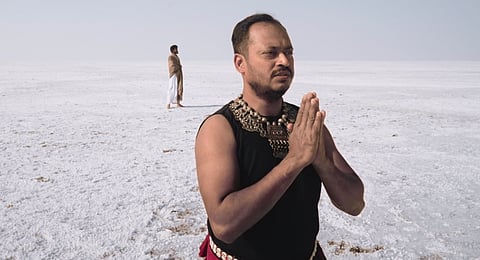
Avikunthak’s adaptation does not attempt to translate Dutt’s poem into conventional cinematic language. There are no grand battle sequences, no elaborate sets, no divine spectacles, no ornate costumes or crowns or weapons. Characters dress as ordinary people. There is nothing to identify them as kings or gods except the extraordinary poetry they speak—for the film preserves Dutt’s Bengali blank verse, delivering it with a deliberateness and care that treats language itself as the primary visual and sensory event.
Instead of studio interiors, the film was shot in some of India’s most geologically ancient and overwhelming natural landscapes: the high mountain ranges and spare valleys of Ladakh and Spiti, the vast white expanse of the Rann of Kutch, the dense forests of Jim Corbett. These are not picturesque backdrops. They are environments that carry their own temporal scale, their own indifferent vastness—places where human figures appear genuinely small, genuinely contingent. And that is precisely the point. By placing Rāma and Rāvaṇa against mountain ranges and rugged terrain, framing them as tiny figures within an overwhelming natural world, the film performs a kind of visual de-magnification. Their legendary grandeur dissolves. They become fragile, exposed, subject to forces far larger than themselves. The mythic becomes, quietly and insistently, human.
This visual strategy is reinforced by the film’s approach to performance. Avikunthak instructed his actors to deliver Dutt’s verses in a flat, expressionless, monotone manner—deliberately stripped of the emotional charge, moral authority, and devotional weight that mainstream mythological cinema invariably bestows upon its divine characters. In traditional representations, Rāma’s voice carries certainty. It resonates with the assurance of cosmic rightness. Here, that assurance is absent. What remains is something more unsettling: a voice that sounds uncertain, almost afraid—a man reciting the words of a god without quite believing them.
Avikunthak has described his cinematic practice through the concept of “infra-realism”—a mode of filmmaking that does not aim to depict movement but to inhabit it, that resists theatricality, narrative momentum, and psychological realism in favor of something more subtle and more elusive. Just as sound waves beyond the range of human hearing can still trigger physical unease or disorientation, infra-realism attends to the faint, almost imperceptible vibrations of human experience—the recurring, quiet rhythms of life that conventional dramatic cinema has no interest in capturing.
In practice, this means that the characters do not speak to one another in any conventional sense. Their voices seem to float over the landscape rather than emerge from direct interaction—disembodied, echoing across vast distances, as though arriving from somewhere outside ordinary space and time. The effect is closer to a ritual chant, or a philosophical meditation, than to dramatic dialogue. It creates an entirely new mode of cinematic storytelling, one that asks the viewer not to follow a plot but to inhabit a duration, to be present within a kind of extended contemplative experience.
The camera, too, remains still throughout—no pans, no tracking shots, no zooms. Each frame is a fixed, carefully composed tableau. The stillness is not passive; it is charged, attentive, almost severe. It refuses the viewer the comfort of movement and insists instead on the weight of space, on what Avikunthak understands through the classical Indian concept of ākāśa—the subtle, all-pervading medium that underlies all sensory experience, the luminous receptive openness within which presence and absence coexist.
The film’s most striking reinterpretation concerns its female characters: Sītā, the captive princess held in Rāvaṇa’s Lanka, and Sarama, the wife of the defector Vibhīṣaṇa and Sītā’s confidante. In mainstream mythological cinema, Sītā’s suffering is routinely staged as melodramatic spectacle—her body trembling, weeping, collapsing into the visual language of victimhood. Here, nothing of the sort occurs.
By delivering Dutt’s elevated blank verse without theatrical expression, Sītā becomes something the tradition rarely permits her to be: a still, sharply defined, intellectually formidable presence. Her voice seems to exist at a slight remove from her physical circumstances, as though refusing to be entirely consumed by them. She does not perform sorrow. Her speech becomes a form of resistance—a kind of mental armor that protects her not from captivity itself, but from the diminishment that captivity is designed to impose.
The scene between Sītā and Sarama is filmed deep within the forests of Jim Corbett, the lush and overwhelming vegetation feeling simultaneously protective and imprisoning. When one woman speaks, the camera shows only the other’s face—a technique that creates a subtle displacement between voice and image, a sonic overlapping that recalls the style of the French filmmaker Marguerite Duras. Their exchange is not emotional but informational, delivered in a minimal, almost ritual manner. In the background, barely audible, are the distant sounds of men preparing for war.
Traditional representations confine women to roles defined by loyalty, devotion, and suffering. Avikunthak’s aesthetic of restraint refuses this. By removing theatrical emotionality, the film allows these women to stand not as suffering wives but as witnesses to—and bearers of—the moral collapse unfolding around them. If Rāma is an anxious hero, the women become something closer to oracles: calm, clear-eyed, speaking with the authority of those who already know how the story ends.
Dutt believed that great poetry does not pass from eye to mind alone—it passes through the ear. Even read silently, the sound of a poem carries its deepest meaning. Avikunthak takes this seriously. In The Killing of Meghnad, sound is not accompaniment; it is substance. There is no background music, no dramatic scoring, and no devotional overtones. The spoken Bengali of Dutt’s verse—maintained in a steady, nearly trance-like vocal rhythm—becomes almost a physical presence within the film, something with texture and weight. What begins as a linguistic experience gradually becomes a profoundly sensory one.
One of the film’s most arresting formal choices is the presence, within the film itself, of an actor playing Michael Madhusudan Dutt—dressed in Victorian-era clothing, reading aloud from the poem. He appears in highly formal, carefully composed frames that contrast sharply with the wild, ancient landscapes surrounding him. While he stands still, the camera moves slowly across geological time. The juxtaposition creates a powerful effect: the nineteenth century and the twenty-first coexist within the same image, the past and present folding into one another, the colonial moment and our own becoming briefly, uncomfortably adjacent.
It is an image that captures something essential about the film’s larger ambition. The Killing of Meghnad is not simply an adaptation of a poem, or a retelling of a myth. It is a reflection on what it means to inherit a tradition—to receive it, to question it, to refuse its simpler satisfactions, and to insist that the most profound form of cultural reverence is not preservation but engagement. It is an argument, made in images and silences and ancient landscapes, that the Rāmāyaṇa has always been multiple, always contested, always alive precisely because it has never stopped being rewritten.
Avikunthak makes his films entirely outside commercial funding structures, with personal resources, in what he calls a ‘mahua style cinema’—evoking the indigenous liquor brewed in Adivasi regions: handmade, local, unindustrialized, resistant to mass production. The phrase captures something of the film’s spirit. This is cinema that refuses to be consumed easily, that asks something of its viewer that insists on its own terms. In a moment when the Rāmāyaṇa is being mobilized as an instrument of political consolidation, that refusal is not merely aesthetic. It is an act of cultural conscience.