
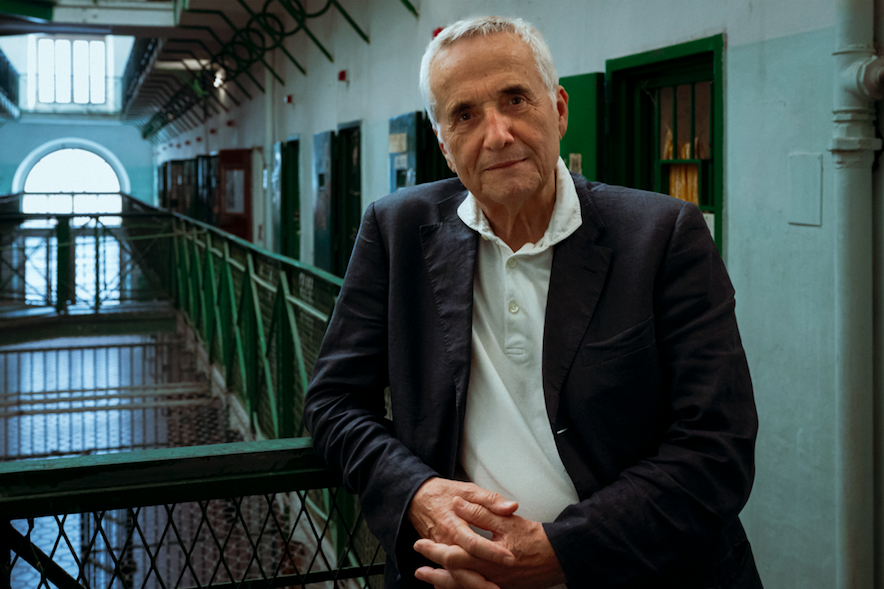
Marco Bellocchio is one of Italy’s film-making gemstones. He is an intrepid cinematic voyager, who explores society through audacious anti-authoritarianism and social reflection. His attentive visionary eye captures humanity through oneiric realism. As a result, during his over 60-year career and 50 cinema and tv productions, Bellocchio, has encompassed a wide range of genres and subjects that have conquered audiences worldwide.
Portobello is the HBO series through which the Italian cineaste retraces one of Italy’s most sensational failures in the Italian legal system: the downfall of an innocent public figure, RAI television presenter Enzo Tortora. Since 1977, Tortora had hosted Portobello, a prime-time show that had reached 28 million viewers — all eagerly awaiting for the contestant who could get the show’s parrot to speak. By the 1980s Enzo Tortora was the king of Italian television. The President of the Republic, Sandro Pertini, had named him Commander of the Republic and Tortora had also became the champion of philanthropic causes such as the fundraiser for the victims of the Irpinia earthquake. However, this man’s impeccable reputation was stained and questioned on June 17th 1983, when the Carabinieri picked him up from his hotel room, because he was suspected of being part of the mobster group called New Organised Camorra. The first accusation came from Giovanni Pandico, a trusted man of boss Raffaele Cutolo, who regularly watched Portobello from his cell.
This was the time when the mafia repentants, known as ‘pentiti’, by contributing to the capture of their associates and the disintegration of the criminal organisation would benefit from substantial sentence reductions. In fact, after Giovanni Pandico several other ‘repentants’ got on this bandwagon, accusing Tortora of dealing cocaine for the mob. Besides Pandico — who was nicknamed ‘o Pazzo’ (the Madman), because he had been diagnosed with schizophrenia and mythomaniac tendencies — there was Pasquale Barra, known as ‘o animale’(the Beast), for his brutal murders; Gianni Melluso called ‘o Bello’ (for his good looks), and several others. All of these testimonies dragged Enzo Tortora in a legal odyssey that unjustly convicted him as a member of the Camorra and drug trafficking in 1985, sentencing him to 10 years of prison. He was acquitted of all charges by the Supreme Court of Cassation in 1987.
Portobello marks Bellocchio’s second historical miniseries after 2022’s Exterior Night, about the kidnapping of Aldo Moro, and features the same lead player Fabrizio Gifuni. The filmmaker has spent his cinematic career exploring the smoke-filled rooms of Italian history, whether it was tackling the Red Brigade terrorism of the Seventies with Good Morning, Night; or the repentant mafia culture of the Eighties with The Traitor; or the euthanasia debate of the Nineties during the Berlusconi IV Cabinet with Dormant Beauty; or even papal conspiracies of the previous century with his film Kidnapped. With Portobello the sloppy judicial system is placed under a magnifying glass, along with the fickle public opinion that is easily influenced by the media circus.
The first two episodes (of a total of six) premiered at the Venice Film Festival, and those who will binge-watch the series will not feel the weight of the marathon viewing. On the contrary, they will be spellbound by the script penned with such humane detail by Marco Bellocchio, Stefano Bises, Giordana Mari, and Peppe Fiore. The cinematography by Francesco Di Giacomo, plunges spectators in an atmosphere of emotional gloom and historicity, enhanced by Andrea Castorina’s set design and Daria Calvelli’s costumes, that channel the authenticity of the era that is being portrayed. Every single cast member is pitch perfect for their role: Fabrizio Gifuni as Enzo Tortora, Lino Musella as Giovanni Pandico, Barbora Bobulova as Anna Tortora, Romana Maggiora Vergano as Francesca Scopelliti, Massimiliano Rossi as Pasquale Barra, Davide Mancini as lawyer Raffaele Della Valle, Giovanni Buselli as Gianni Melluso, Paolo Pierobon as lawyer Alberto Dall’Ora; as well Federica Fracassi, Carlotta Gamba, Giada Fortini, Irene Maiorino, Giovanni Buselli, Davide Mancini, Gianluca Gobbi, Fausto Russo Alesi, Massimiliano Rossi, Pier Giorgio Bellocchio, Alessio Praticò, Alma Noce, Salvatore D’Onofrio, Francesco Russo, Gennaro Apicella, Luciano Giugliano, Alessandro Fella, Antonia Truppo, Gianmaria Martini, Fabrizio Contri, Gianfranco Gallo in the role of Raffaele Cutolo, Tommaso Ragno in the role of Marco Pannella, Valeria Marini in the role of Moira Orfei, Francesca Benedetti in the role of Paola Borboni and Alessandro Preziosi in the role of investigation judge Giorgio Fontana. All are worthy of mention, for their formidable performance that is smoothly weaved together by Francesca Calvelli’s editing and the pace of Teho Teardo’s music score.
Marco Bellocchio — who was honoured with a retrospective at MoMA in 2014 — has once again provided an insightful analysis of Italy’s contemporary history, showing how certain repercussions can affect today’s political fragile equilibrium. Portobello is a dramatic story of how a judicial broken system can destroy the life of an irreprehensible man. In fact, Enzo Tortora developed cancer and died in May 1988 at the age of 59, 11 months after his acquittal. With this HBO series what is shown is how even honest judges, in good faith, who fought crime on a day to day basis, were blinded by a missionary idea of justice, to the point of refusing to acknowledge their own mistake. The six episodes portray a wide spectrum of the entire saga, including some of the intellectuals and politicians who publicly defended Enzo Tortora, like politician Marco Pannella who asked him to run for his party, or journalist Enzo Biagi who wrote an op-ed in favour of his innocence.
Aside from the political and social analysis, Portobello, will leave spectators wondering how easy it is to smear someone’s reputation out of envy and spite. The domino effect in the slander campaign can get out of control. The masses don’t seem to demand proof for defamation, and this is something we can observe in the digital era, where too often clickbait rules over hard news.