
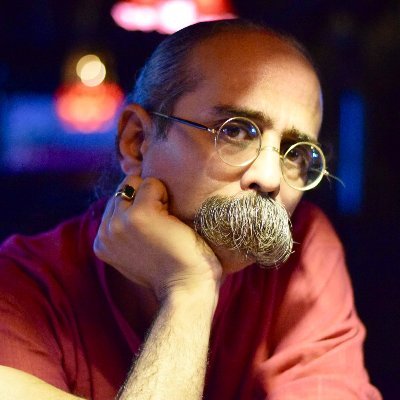
(Ashish Avikuntak talks about ‘Nirakar Chhaya)
Ashish Avikunthak, who has been making films in Bengali since the mid-1990s, is less known in India. In 2014, he was name Future Greates by Art Review. His films have been shown world-wide in film festivals, gallaries and museums. Avikunthak’s films are highly formal meditations on ritual, time and death. They are rooted in Indian religion, philosophy and history, without being about any of these in an anthropological way. His works strongly resist being so easily packaged for the new global art world circuits.
He has made a half dozen short films and six features – Nirakar Chhaya (2007), Katho Upanishad (2011), Rati Chakravyuh (2013), Kalkimanthankatha (2015), Aapothkaolin Trikalika (2016) and Vrindavani Vairagya (2017).
He has a PhD. In Cultural and Social Anthropology from Stanford University and has earlier taught at Yale University. He is now an Associate Professor in Film / Media Studies at Harrington School of Communication, University of Rhode Island.
His first feature film, ‘Nirakar Chhaya’ is based on a famous Malayalam novel ‘Pandavapuram’ by distinguished novelist Sethumadhavan. A film trapped between two monologues. A lonely and abandoned wife’s fantasy comes to life when the paramour she invokes springs forth and transforms her reality. This interpretation of a novel is one of the best examples of adaptation of literary works into cinema.
- As a Bengali, what attracted you to Sethu’s Malayalam novel Pandavapuram?
First I am not a Bengali. I am a Punjabi, with a partition history who was raised in Calcutta. I had read the English translation of the book in 1998. I had picked it up in a bookshop in Bombay and then read the book in one sitting in an ST bus from Dhanu to Nasik. There were number of things that I was attracted by in the book. The first was the possibility of magical transcendence present in the book. A story that was rooted in a real world, but at the end hypnotically moved into an enchanting, parallel universe that resonated with by me in a deep way. Although culturally deeply located in Kerala it’s meta-narrative hovers between the magical and the real world that had a cinematic possibility that was almost alluring. For me, it was a book at the moment, I finished in a rickety bus maneuvering the Western Ghats near Trimakeshwar, I knew immediately that I had to make the film. At the kernel of Pandavpuram is a possibility of transcendental magic, a mystical yearning that mesmerized me both as reader and also as filmmaker who saw cinema running in front of my eyes as I was reading it. Narratively at the heart of the book is a melancholic and forlorn sexual fantasy of a lonesome woman that seduced me. The novel is historically and culturally located in the dying matrilineal society of the Nair, but that desire had a universalism that I felt could effortlessly be reconfigured in urban Calcutta world, or for that matter anywhere.
- The novel has an unconventional structure – an imagined world, movement between real and non- real. A symbolic world which is deeply melancholic. What were the process of conceiving the novel as a film?
As I said it was exactly this unconventional structure that attracted me to the book. I took the book as a starting point and not a hegemonic text that I had to be created cinematically word-by-word. I wanted to use the original text as a jumping board into creating my own parallel universe. Nirakar Chhaya is not an adaptation of Pandavpuram but a reconfiguration. By reconfiguration I mean a practice in which I invoke the essence of the original text but reframe it within a cultural, ideological and personal framework of my own provenance. Here the essence of the text is retained, but I profoundly shift its structural configuration. I employ the original text to leap frog into creating my own universe. It is a form of ideational hitchhiking. The original text is one of the many vehicles I jump on into my own creative journey. For me the novel ended when I read and what I made was a film that emerged from the child but it was something I have conceived. In this process I first worked on the script with my collaborator and then I sent the script to Sethu for him to have a look at it. He was very kind to me and he was open to the script that I had written and gave his go ahead.
- Colour and blalck and white is used to capture real/non-real/imaginery world. Different colours are used. Yellow for example. Yellow is a prominent colour used in the novel. Please elaborate.
The movement between colour and b/w can have multiple meaning, which is depended on the viewer. For me it was not about dichotomy or dialectics past/present, real/non-real, or real/imaginary. For me the shift between color and b/w is a structural play of the cinematic texture. It is a formal articulation. I am interested in producing a haptic affect through my films. This is an effect of somato-sensory perception produced by the filmic image, through the careful manipulation of its texture. I exploit both the chemical and the structural nature of the filmic image to produce a visual effect that creates an affective textural impact. Usage of multiple kind of film stocks having different gradation, granularity, quality and age, chemically alerting the images to produce various effects, swiftly and suddenly moving between color and black and white images within a diegetic moment, variation of the frame rate, the modification of the exposure and the sharpness of the image are some of the strategies that I employ to bring about a haptic affect. I do this because I want the cinematic experience to move beyond the visual into the visceral. I seek to invoke a primordial effervescence through the moving image that is phenomenologically not just about seeing, but is also about feeling.
- Another aspect is music. Same music is used in different scenes as leit-motif. The sound is loud, visuals are calm. I would like to know more about sound.
The music in the film is original compositions of a doctoral student of music at Stanford University. I spend quite sometime after the editing of the film at the Stanford University Music Library listening to music that the students were composing and producing. It was in this process I came across Nurit Jugend, who is an Israeli-American composer. Her works I had heard in the University and I approached her. Her music was very passionate and it matched the intensity of my film. She then gave me the music that she had composed over the years and I used them in appropriate places in the film. The music is her original compositions that she composed as a student and were performed by various ensemble. In the film I used the music as a leit-motif to resonate with the emotional crisis of Devi, her melancholia, her disenchantment and her unfullied desires.
- Repetition is another aspect of the film – repetition of sound, scenes, objects, etc. Particularly the tender coconut cutting scene and the chicken cutting scene. Scenes of slicing of banana, cucumber, etc. are also to be mentioned here. Please tell me more about this.
For me the cutting represented an inherent emotional and spiritual violence inside Devi. In a way this is a signal to the ritual sacrifice that is repetitive. Here I think is the subtext of the cinema of religiosity that I am talking about. The chicken cutting scene for me is the penetrating kernel of the film. It is the core around which the films narrative structure cyclically rotates. It is because of this scene that the film has not been released in India. The Censor Board wanted me to delete the scene and I refused. So the film has been denied a censor certificate. I don’t work as a filmmaker I work as an artist. My films cannot be altered to fulfill the fancy of a moralistic state. In a sense this chicken cutting scene in a real sense is a metaphor of the violence that the world inflicts on the film itself.
- You have mentioned about cinema of religiosity. Will you elaborate this in the context of NirakarChhaya?
In my films, I create an aesthetic idiom that I call mythic realism. This form of cinema is a filmic intersection of the mythological genre and the neo-realistic aesthetic. Earliest cinema in India was mythological and, for the first two decades, the spectacle of this genre dominated Indian cinema until it was displaced by melodramas and social dramas in the 1930s. Again with the rise of television in the 1980s, it was the mythological genre that dominated and captured the imagination of the nation – a time when I was growing up. My filmic intervention is a practice that engages, experiments, transforms, and reconfigures this genre of cinematic representation. This programmatic idea is inflected by neo-realism, especially the way it got reconfigured in India by Ritwik Ghatak and later by the avant-garde filmmakers of the Indian New Wave – Mani Kaul and Kumar Shahani. Analogous to magical realism, mythical realism is a world where mythological times inhabit the every day, and simultaneously where everyday actions become mythical ritual. I come from a middle class, religious Hindu family, where divine figures, religious symbols and mythic objects would infuse my urban everyday world in Calcutta. It is this seamless interplay of realism, ritual and myth that I evoke in my work. My films displace the mythic from the domains of the heavenly to the everyday banality and mundaneness of the quotidien. In Nirakar Chaya, this mythic relegiosity is present mostly as a subtext rather than an overt artcilaution.
- This takes to another aspect, Time. According to Indian philosophy, it is Kaalchakra. How do you look at this? You once said that “more than “embalming of time”, I think of cinema as “conjuring with time” or as “maya”. With referencto Tarkovsky’s famous idea ‘Sculpting in Time’, will you please elaborate?
For me cinema is primarily about Temporality. Early cinema was about Temporality. The first cinematic representations were about time… the workers getting out of Lumeire Brother’s factory or the coming of the train. Cinema was about image, the moving-image. This movement was through times. The movement was so attractive that time moved into the background and the Narrative of the movement came into the foreground. And then narrative colonized the possibility of the movement in time. I am interested in movement through Temporality. In this process I do not discard narrative, because I cannot after more than 100 years of narrative colonization over time in cinema. What I do is to subvert narrative. I do not discard narrative I just radically shifts its focus. You can even say that my films are post-narrative – conceptually analogous to the idea of post-colonial. As in – we can in India never get outside the colonial because modernity was bestowed upon us through the colonial experience. If I take this analogy further, then lets say if pre-colonial India was outside of history and was within a zone of “timelessness”, as some historian and anthropologist have argued. So pre-colonial India or pre-modern India was fundamentally about Temporality, as one can see in our epics and Puranas and especially in our performative world. In the same way pre-narrative cinema was also about Temporality. In the same way as we cannot escape history in modernity so we cannot escape the narrative in cinema. In India the power of the cinema came through narrative – through the Phalke via “Life of Christ”. So for me, my cinema is post-narrative, as in it is committed to narrative, but I want to bring Time into the foreground. I want through my cinema a play with temporality. And then moment I utter that, it means within the framework of Indian metaphysics that I am talking about Maya… Then my cinema becomes cinema of maya – a conscious, awareness of “conjuring with time”. And the concept of Maya is integral to Kaal Chakra.
- You struggle to find money to produce your films. With new technology available cheaply, how do you see the future of your.
I don’t struggle to find money or to raise money. I struggle to make films with my own money. It is an important distinction that I am making. Very soon, when I started making films in 1995, I realized that there is no way to raise or find money to make my films. I make films on my own, with my own money. It is this mode of production that significantly informs my cinematic practice. I do not see my films and videos as a commodity that circulates in the world of capital. I see them as autonomous pieces of work that can exist irrespective of circuits of capital. It is this idea of a cinematic work devoid of its dependence on circuits of capital and finances that drives my practice of art production. I don’t work with a market in mind therefor I don’t look for money or search for money. I work more like an artist than a filmmaker. I started this practice the hard way in the 1990s, when filmmaking was very expensive. I did all kinds of work to make money, and most importantly live frugally and save money to make films. For instanceNirakarChhaya was made by saving my Phd student stipend at Stanford University for seven years and living very frugally in US – a life style that I still maintain. So for me this way of filmmaking is a political mode. It gives me full control over the filmmaking process, without any dependence on funds, institutions and market. Today more than ever before this mode of filmmaking is possible than ever before- technology has become inexpensive and so have new forms of distribution through the internet. So if took me around five years to make my first feature film, today I can make a feature film a year. Now, for me the struggle now is not so much about money but to get people to see my work.
- In the age of globalisation, a standardisation is happening everywhere — in culture, beauty, taste, food, etc. What do you think about using local myths and traditions against cultural invasion.
I do not make film to fight globalization, transforming beauty, taste or culture. As an anthropologist I am aware that they are in constant process of flux and change constantly. I am deeply aware of this change but do not see my films as an intervention in this world. My cinema is not a gesture or an act of protest in this transforming world. Undoubtedly my films are located in this transforming world, but I do not use religion/myths or local tradition as an act of politics. For me my films emerge from a deeper core than mere political, cultural or social gesture.
- Somewhere in between in the name of ‘modernism’, we have avoided using traditions in cinema. Left wing thinking widely spread the idea that usage of tradition is revivalism. But you use lot of traditional elements in your films – kathakali, durga, kali etc. Please elaborate.
Ah, this is a politically and historically loaded question. Let me try to answer. I think modernity is an idea that we in India are still trying to negotiate. It is till a work in progress. The history of India in the past two hundred years is a testament to that complex negotiation process. I think it is very simplistic both by the Left and the Right to pigeonhole tradition, religion, and culture within their ideological cocoons. My usage of religion and tradition come from very different core. It is not political or ideological. It come from a deeper framework that as I have tired explained within the framework of cinema of religiosity. Another way of looking at my films would be with in the idea of Cinema of Prayōga. It is term that has been coined by the film critic Amrit Gangar.
Cinema of Prayōga is a radical conceptual framework, which originates from the polyphony of Indian culture and philosophy. It challenges the dominant film discourses by locating itself in the ancient pre-modern tradition of prayōga (innovation) and kaal (time in-continuum). Cinema of Prayōga is a bold alternative to understand Indian as well as Euro-American experimental filmmaking practice as an experience of thinking and feeling. It harnesses the Indian notions of time and space for an inclusive cinematography across cultural and national boundaries. CinemāPrayōga is a radical attempt to steer away from the image, a cinematographic contradiction, towards an evocation of an aesthetic unity. Being a non-absolutist and inclusive philosophy, it is rooted in a human quest that is eternal thereby composing Cinema of Prayōga as a continuing process in time and space, of cinema, and life thereof. Cinema Prayōga is an attempt to subvert its status as a visual medium, to an understanding of its essence as a temporal medium. Works ranging from the early works of Dadasaheb Phalke, Mani Kaul, Aravindan, Kamal Swaroop to the contemporary filmmakers such as Amit Dutta, Vipin Vijay, Argho Basu, Kabir Mohanty and my works have been included in the discourse.