
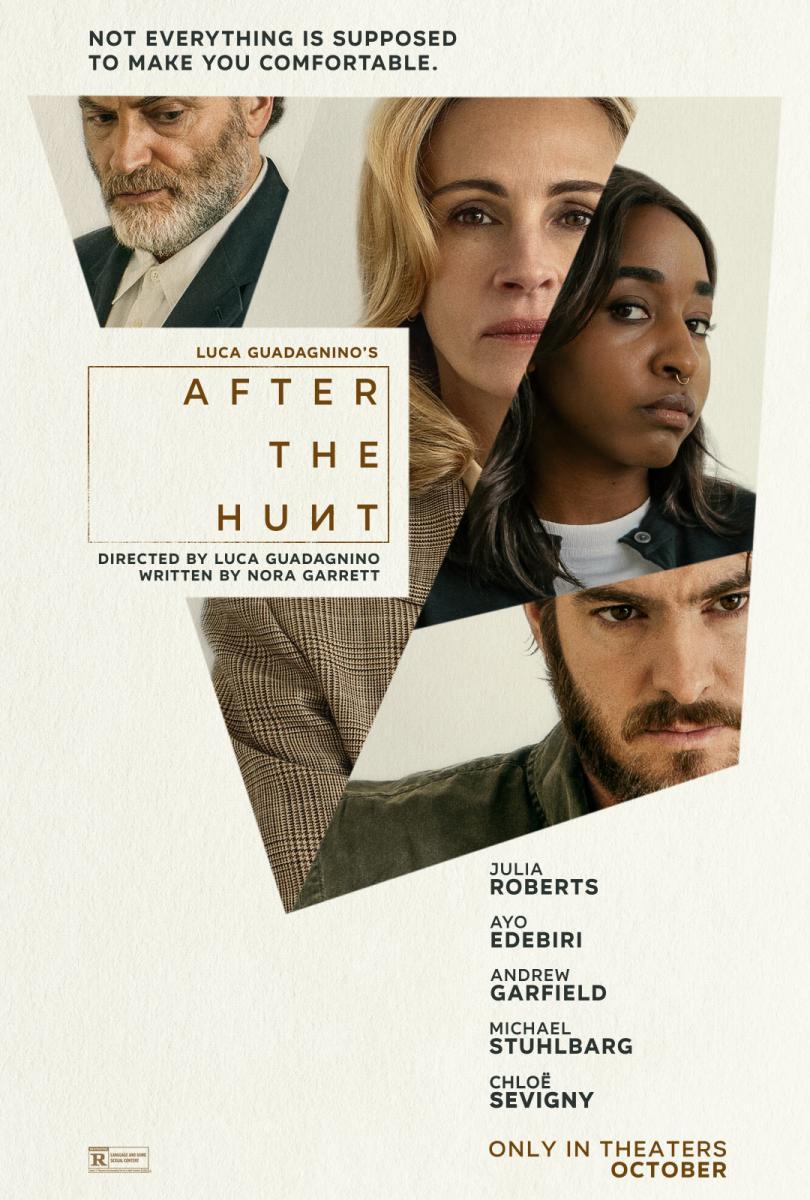
When Luca Guadagnino’s After the Hunt premiered at Venice on 29 August 2025, it earned both a six-minute ovation and a storm of debate. Julia Roberts, at the centre of the film, delivers a career-defining turn as Alma Imhoff, a Yale philosophy professor whose standing begins to unravel when one of her students, Maggie (Ayo Edebiri), accuses Alma’s colleague Hank (Andrew Garfield) of sexual misconduct. What might have looked like a straightforward #MeToo case is anything but: from the opening scenes, Guadagnino plants seeds of ambiguity around Maggie’s motivations, her careful orchestrations, the calculated timing of her revelations. The balance of power between all three characters proves far more volatile than initial appearances suggest, shifting with each new disclosure.
Guadagnino, who explored the erotic tensions of competition in Challengers and the suffocating weight of bourgeois tradition in I Am Love, here turns his gaze to academia, a supposedly meritocratic space where privilege and vulnerability coexist in ever-shifting configurations. Alma, wealthy and well-regarded, holds her students’ futures in her hands, yet remains precariously un-tenured. Hank, her rival, carries male privilege but not class privilege: he is the one who “made it” through scholarship and effort, rather than inherited wealth. Maggie, meanwhile, is both Black and a woman, but also the daughter of major donors whose substantial financial contributions to the college command institutional attention. Who holds the advantage in any given scene depends entirely on which of these factors the institution — and the moment — chooses to amplify.
Much has been said about white and male privilege, yet Guadagnino excavates something more insidious: status privilege, the kind that flows through class, pedigree, and institutional capital. Is higher education truly the gateway to academia, or has it become an elaborate tool to provide the illusion of meritocracy? The data increasingly suggests the latter. Across Western democracies, elite reproduction has intensified rather than diminished. In the UK, privately educated students are 55 times more likely to reach Oxbridge than those on free school meals. In France’s grandes écoles, Parisian students have 25 times better odds of admission; those with academic parents, 83 times; at Polytechnique, legacy students enjoy a 300-fold advantage. In the US, children from the top 1% are 77 times more likely to attend Ivy League schools than those from the bottom 20%. Despite decades of supposed democratisation, social mobility has stagnated or reversed: in most OECD countries, it now takes five to six generations for those born in low-income families to reach the mean income — a century ago, it took three.
One of the film’s most cutting early moments captures this reality. A privileged white male student complains that in today’s climate, only women can succeed. The women in the room exchange glances before countering: is it really harder for him now, or is he simply experiencing, for the first time, competition on a playing field that’s become slightly less tilted in his favour? Guadagnino uses the moment not to lecture, but to expose how privilege feels invisible until questioned, at which point its holders experience even the smallest correction as existential loss. Is it really harder for him, or is there simply growing awareness about dice that have always been rigged?
The brilliance of After the Hunt lies in its refusal to collapse into simple moral categories. Maggie may be lying, or telling the truth; seeking justice, or weaponising a cultural moment. But Guadagnino pushes further, asking: when academia becomes increasingly privatised, when colleges depend on donor money, who will institutions protect? Will they stand by principles of justice, or will they sacrifice those without powerful backing while shielding those who fund the endowment? The film suggests that #MeToo may have given some women a voice, but in spaces where money talks loudest, that voice only carries so far.
Alma may be defending principle, or protecting her position. Hank may be victim or perpetrator. Every character is compromised, every privilege countered by vulnerability. The film never lets us rest with an easy answer, instead revealing how different forms of privilege — gender, race, class, job security — collide and reconfigure depending on who holds institutional power at any given moment.
What makes Guadagnino’s vision particularly sharp is his observation about the resilience of privilege itself. When Hank’s academic career implodes, he doesn’t face the total ruin he — and countless accused men — claim awaits them. He lands elsewhere, pivots, survives. His prophecies of destruction prove hyperbolic. The film quietly undermines the narrative that #MeToo has gone “too far,” that men’s lives are being “destroyed.” Instead, it shows how privilege, even when temporarily disrupted, provides a cushion against true downfall.
This is the film’s most uncomfortable revelation: not that meritocracy is entirely closed to outsiders, but that even when insiders fall, they rarely fall far. The scandal that might destroy someone truly vulnerable becomes, for those with any form of structural advantage, merely an inconvenient career pivot. Hank may lose his position at Yale, but his education, his networks, his cultural capital remain intact. The game isn’t just rigged in who gets in — it’s rigged in who survives getting pushed out.
In the end, Guadagnino resists resolution, offering instead a portrait of privilege as both armour and safety net. After the Hunt doesn’t just interrogate #MeToo or academic politics — it dissects institutions that claim to reward merit while data increasingly shows they perpetuate dynasty. The six-minute ovation was deserved, but the discomfort the film provoked should last much longer. In an era where the top 1% increasingly hoards not just wealth but educational opportunity, where meritocracy becomes mythology backed by statistics showing declining mobility across the Western world, Guadagnino’s film feels less like fiction than diagnosis.